I have read a lot of memoirs...really did not like this one at all. The style of writing was sophomoric and something about this story didn't ring true. My feeling is that there was a basic truth there but it was highly embellished to make it more interesting. English The story is a shocking misrepresentation of the recent Chinese history and a shameless fabrication of a heroic story that never happened and could never happen. I'd like to quote Fang Zhouzi, a freelance Chinese write who just recieved John Maddox Prize for been an ardent whistle blower for misdemeanors in scientific research, who recently provided a detailed rebuttal to some of the books claims.
I was a young child at the beginning of the Cultural Revolution. My home and those of my close relatives were all ransacked by the Red Guards. They took away almost everything from us. For a brief period afterwards, my parents were away from home and I was taken care of by one of my cousins who was the middle school age. When she walked me to the kindergarden before going to school herself, the other kids in the neighborhood would spit on her. This period was so brief that I have no memory of it. My parents came back very soon and we had a basically normal life, considering the circumstances.
The reason I told my own experience during the Cultural Revolution is to provide the background for my criticism of Fu's book. I did not read her book itself, but read the story told in the book from the Chinese version of the Forbes article and other reports on the book, including the NPR story.
The first incredible detail in the book is the claim that Fu was taken to the labor camp at the beginning of the Cultural Revolution while she was eight years old. She stayed at the labor camp for ten years. She also said that she had to take care of her four year old sister. This means that the labor camp had children as young as four years old. Of all the people who went through the labor camps before, during, and after the Cultural Revolution, there had not been a single person who reported seeing young children in a labor camp.
A photography of her from that period provided by herself in fact contradicts her story. The photo shows her with a group of children posing in front of a flag. The Chinese characters on the flag read Red Guard Brigade. All of the children in the photo wore armbands indicating that they were members of the Red Guard. I remember these armbands because many children were not allowed to wear them due to their bad family background. The photo shows that they were in a park. In fact, this was a park in the city of Nanjing. This was probably a photo taken when this group of Red Guard toured the park, perhaps on a weekend trip. It is clear that instead of being sent to a labor camp, Ms Fu was a member of the Red Guard herself.
The second incredible detail was how she got into college. She said that she entered Suzhou University in 1977. This was incredible in two ways. First, Suzhou University did not even exist until 1982. Although it was first built in 1900, it was split into several colleges in 1952 after communists took over China. The main part of it became Jiangsu Teacher's College. In 1982 it was merged with some other colleges to form Suzhou University again. Let us be charitable here and assume that she entered Jiangsu Teacher's College in 1977. But then there is a bigger problem. In 1977 entrance into a college was a privilege reserved for the political elite. It required going through a political evaluation. People who had questionable political backgrounds were not allowed into college. If as she said that she spent ten years in a labor camp, that would definitely disqualify her from any college. Conversely, if she indeed entered college in 1977, it would mean that she was a member of the politically privileged during the Cultural Revolution. This would also be consistent with the possibility that she was a member of the Red Guard.
But let us be charitable again and assume that she remembered wrong again. She would actually take the first national college entrance exam after the Cultural Revolution in 1977, and entered college in 1978. But even then it would not be consistent with her story. There was still the problem of political evaluation which was still used in 1977 but dropped in the subsequent years. There was also a problem of how she was able to study for the exam. In 1977 because it was the first exam in more than ten years, there were many times more people who took the exam than what would be on average. The competition was fierce, and the admission percentage was extremely low (about 4.8%). It would be highly unlikely that someone without any formal education would have been able to pass the exam. I had several cousins who took this exam, and none of them passed.
The biggest question was how she came to the US. She claimed that she wrote an article about infanticide in China while she was in college. This article was said to be published on the People's Daily in 1981. Its publication led to an UN sanction against China's one-child policy. As a result, Fu was jailed for a few months, then was exiled to the US. This was just not something that could happen in China in the early 1980's. First of all, People's Daily would never publish such an article. Indeed, no one has been able to find such an article during the time she claimed. Second, the UN never imposed any sanctions on China for its brutal birth control policies, as much as many people wished that it would. Third, exiling dissidents to the US was not a practice by the Chinese government in the early 1980's. A famous dissident of that period, Wei Jingsheng, was not exiled to the US until 1997, after spending 18 years in various Chinese prisons.
In the early 1980s, it was very hard for anyone in China to be able to get permission to leave China and study in the US. That Fu was able to do this would indicate again that she was from the privileged class, not persecuted as she claimed in her book.
Hardcover I enjoyed this read, but found that it stretched my credulity more than once. Not that I don't believe that China's Cultural Revolution would leave an 8 year old living on her own, but that she single handed-ly opened the floodgates revealing China's infantacide, that she happily met with her tormentors as an adult....Some of it seemed just a mite too fantastic for belief.
I of course liked to see that she rose from poverty and abuse to success, but Im seeing now several reviews questioning her honesty in telling her story. There was something in the tone of the book that leaves me unsurprised at these accusations... English I don't read a lot of memoirs. So, BEND, NOT BREAK is either a perfect example of why I don't, or it's simply a terrible book.
Ping Fu must be a brilliant person. She apparently overcame great odds as a young girl in China, was then quietly expelled from China, and eventually succeeded in America as the head of Geomagic, a software company that works to create 3D products.
This memoir, however, is poorly written (style-wise), full of inaccuracies (many since recounted by the author), and begs for, alternately, pity or admiration. It goes from Poor, poor me, to Aren't I amazing! in 0 - 60 words. She generally takes all the credit for her successes, but none of the blame for her failures. For example, on page 260 of the paperback edition, she says, Still, I don't know how my thesis research [on female infanticide in China] had gotten me in trouble. Really? Such a smart person, and yet she couldn't figure out why the Chinese government under Chairman Mao would object to that? Alternately ... on page 130, Ping Fu tells about the birth of her daughter: The birth was easy. Nurses said that in all their years of midwifing, they had never seen a delivery like mine: I didn't push my baby out with cries of pain, but with hysterical laughter. Okay, people, I've had four children. The second one I delivered by myself at home (it happened that fast). Giving birth was easy for me, but NO ONE laughs their way through it. Trust me.
If those examples aren't enough, I could cite numerous passages of Ping Fu's false modesty. To summarize the temporary failure/setback of her company, Geomagic, Ping blames her lack of confidence to trust herself. In other words, I am so smart, I should have never hired another CEO. He was just a front, and I would have done better. And, including this comment from Stuart Frantz, one of her board members: I always thought you were a visionary, Ping. You're also psychic. just enforces her gigantic ego.
I view this book as a failure and a bore. One Star. Ping Fu 0 star.
Anyone who knows about modern Chinese history can easily spot numerous fabrications, inconsistencies and misleadings. Even the photo she provided does not match the description in her book. I must agree with this review on Amazon:
http://www.amazon.com/gp/cdp/member-r...
What a waste of time, at least I did not pay for this book!
On the other hand, why I am not surprised that such a book becomes a best seller? Sadly people will read it because it fits their imagination about China. Gang rape, child imprisonment, forced-abortion and a story of a rag-to-rich superwoman, what else you are looking for?
EDIT(7th April 2013): The main reason I dislike this book is when the author lied about her experiences in Cultural Revolution, she shamelessly took advantages of the very real suffering of Chinese people in the time period.
For the topic of Cultual Revolution, I recommend Ten Years of Madness: Oral Histories of China's Cultural Revolution by Feng Jicai (http://www.goodreads.com/book/show/16...) Bend, Not Break: A Life in Two Worlds
Since I wrote the`review in February, I discovered that there may be some mis-truths in this book, which I am sorry to say I did not know originally. I didn't question anything because I just assumed that if someone is writing a memoir, everything it is will be the truth as the person remembered it. I felt I should add this to thhe review.
This is a memoir about a woman who lived through the Cultural Revolution in China, was taken away from her parents at age eight where she lived with other children who were to be re-educated because they came from affluent families. She raised her little sister (four years old) in this environment for ten years. When she was 10 she was working in a factory. The ten years she spent here were abusive and sad. It’s an amazing story because somehow she survived and became CEO of a 3D software company and was named Inc. Magazine Entrepreneur of the Year. She was exiled from China and came to the United States with nothing. It’s a story of the American dream come true. But it was her resilience and her ability to blend the two cultures that helped her succeed. I’ve read many stories like this and clearly this one is unique. It draws you in and pretty much keeps you there until the end. 288 After reading some of the comments below and doing a bit of research of my own, I have to retract what I'd written initially. I leave the reader to do his or her own research before deciding the veracity of this book. A lesson learned for me.
Ping Fu Began the book without having read the storm of reviews this book has generated, so didn’t have any preconceived notions. I’ve read several books with the Cultural Revolution years as the backdrop, so was interested to see how this one compared. Overall, it wasn’t as rich and engaging as others; I found, what I thought, were a few inconsistencies, although Ping Fu might have had a slightly different experience, only she knows. I found I had more questions than answers to several parts in the book â€" for example, Uncle W suddenly shows up in Nanjing to visit her, stays a few weeks, and then heads back to Tianjin. She didn’t know who Uncle W was, had never met him before, but he decides to spend his annual leave visiting her in Nanjing? The most significant question is why she is able to leave China to go to the U.S. to study. The Chinese government wasn’t happy with her, and her punishment was being able to leave China for the U.S. â€" really? That would actually be a reward! And then there’s more questions about her trip to the U.S. and how she ended up getting to where she needed to be â€" not to spoil it for others â€" other than to say that that process is a bit questionable. The book isn’t knitted very well together, there were typos and incorrect use of words â€" “site†as opposed to “sight†and one glaring attribution of Jack Welch being CEO at GM rather than GE! It’s not that difficult to get these right. Apart from all that, it was interesting to get Fu’s perspective, memoir vs. fiction aside, on her life and how she navigated the challenges she faced as a child and as an adult. This was incredibly inspiring and beautifully written.
This is a memoir of a Chinese Amercian who had to leave her home country after being kicked out.
at 25 she had to leave all her family members and leave. upon arriving in America, she struggled a lot, she didn't know but 3 words in English, she worked really hard and now she's one of the best entrepreneurs.
her story is motivating although, she struggled a lot during her childhood as a black element during the Chinese Cultural Revolution and forced to be a mother at age 8 and live alone with her sister who at the time was 3, she turned her life around.
I read on the internet that some of the things she had written were, in fact, untrue which made me reluctant to pick up the book and sat on my shelves for over 3 years XD. 288 This book has a unique status in my did not finish shelf, for I never even started it!
I saw it on the shelf at the library, saw that it was a New York Times bestseller, and the blurb sounded fascinating. A book about life in China during the Cultural Revolution, followed by a rags to riches, happy-ever-after life in America. What was there not to like?
Then I got home and looked at the GR reviews.
I am not even opening the book. Tomorrow it goes back to the library. It sounds like lies and cods wallop from start to finish. Thank you GR folk for waving the warning flag and steering me away from the rocks. Bend, Not Break: A Life in Two Worlds
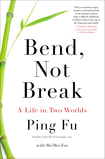
“Bamboo is flexible, bending with the wind but never breaking, capable of adapting to any circumstance. It suggests resilience, meaning that we have the ability to bounce back even from the most difficult times. . . . Your ability to thrive depends, in the end, on your attitude to your life circumstances. Take everything in stride with grace, putting forth energy when it is needed, yet always staying calm inwardly.†â€"Ping Fu’s “Shanghai Papaâ€
Ping Fu knows what it’s like to be a child soldier, a factory worker, and a political prisoner. To be beaten and raped for the crime of being born into a well-educated family. To be deported with barely enough money for a plane ticket to a bewildering new land. To start all over, without family or friends, as a maid, waitress, and student.
Ping Fu also knows what it’s like to be a pioneering software programmer, an innovator, a CEO, and Inc. magazine’s Entrepreneur of the Year. To be a friend and mentor to some of the best-known names in techÂnology. To build some of the coolest new products in the world. To give speeches that inspire huge crowds. To meet and advise the president of the United States.
It sounds too unbelievable for fiction, but this is the true story of a life in two worlds. Born on the eve of China’s Cultural Revolution, Ping was separated from her family at the age of eight. She grew up fighting hunger and humiliation and shielding her younger sister from the teenagers in Mao’s Red Guard. At twenty-five, she found her way to the United States; her only resources were $80 in traveler’s checks and three phrases of English: thank you, hello, and help. Yet Ping persevered, and the hard-won lessons of her childhood guided her to success in her new homeÂland.
Aided by her well-honed survival instincts, a few good friends, and the kindness of strangers, she grew into someone she never thought she’d be: a strong, independent, entrepreneurial leader. A love of problem solving led her to computer science, and Ping became part of the team that created NCSA Mosaic, which became Netscape, the Web browser that forever changed how we access information. She then started a company, Geomagic, that has literally reshaped the world, from personalizing prosthetic limbs to repairÂing NASA spaceships.
Â
Bend, Not Break depicts a journey from imprisonment to freedom, and from the dogmatic anticapitalism of Mao’s China to the high-stakes, take-no-prisoners world of technology start-ups in the United States. It is a tribute to one woman’s courage in the face of cruelty and a valuable lesson on the enduring power of resilience.
Bend, Not Break: A Life in Two Worlds





0 Comments